
Maintaining your notes —
whose job is it?
The thoughts, notes and loose ends you toss in get organized by AI into a knowledge base that is sourced, traceable and yours. The upkeep — naming, linking, aligning, tidying — is no longer your job.
You capture, AI organizes, you decide only where it matters.
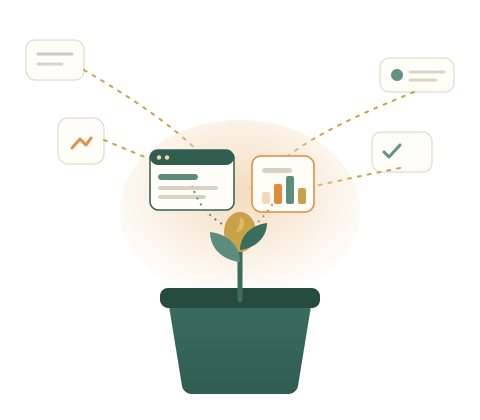
Not a question-and-answer bot — a teammate that takes the tidying off your hands.
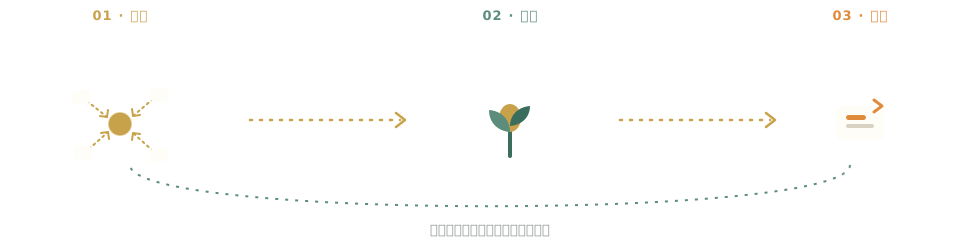
A thought comes in and runs a full loop. AI walks most of the path; only the judgment that can’t be outsourced is left to you.
Seconds, no habit change
Drop a thought from the floating button, a drag-and-drop, or by holding to speak. No need to spell out a full request or learn how to prompt.
Annotate → cluster → focus → crystallize
Fragments get annotated, clustered into topics, focused, and crystallized into an interlinked wiki. Naming, linking, consistency and freshness checks are AI’s bookkeeping.
Only the judgment that can’t be outsourced
What’s worth crystallizing, whether a fact is right — you nod or correct at the key points. AI shows you first; you choose the direction.
Crystallized knowledge flows back so the greenhouse keeps growing. (The harvest-back action line is a direction in progress.)
This product’s manual was written by the product itself.
Greenhouse has a 52-page, interlinked wiki describing itself, crystallized from a single topic. It even keeps two real research corrections — flagging a widely repeated quote whose original source it couldn’t find — as receipts of its own verification.
After you sign in you’ll see (all real screens):
- Knowledge graph with node detail: backlinks and sources at a glance
- Capture and composer: a thought reaches the greenhouse in seconds
- Walkie-talkie voice capture: hold to speak, release to send
- Librarian answers: cites [[pages]], honestly lists gaps when it’s unsure
- Time replay: watch how the knowledge base changed each day
AI does the bookkeeping; you only judge.
Format, links and indexes are kept correct by code; AI only handles what needs judgment. The whole annotate → cluster → focus → crystallize pipeline is verified end to end — not background magic.
Every sentence traces back to where it came from.
Crystallized content is sourced sentence by sentence and vetted by credibility; when things conflict, both readings stand side by side instead of one being chosen for you. Librarian answers are double-checked, and when it can’t answer it lists the gap rather than inventing one.
Plain markdown and git — take it anytime.
Your knowledge base is standard-format files; each key action is a commit, history replays, and same-day changes can be undone. We keep the cost of leaving deliberately low.
We don’t replace your tools
The AI cultivation layer sits on top, your storage below, a dashed read line between. Wherever you already jot things down is the way in — Greenhouse takes over the organizing, not the moving.
Obsidian gives you the best manual tools; Greenhouse takes the organizing off your hands entirely. Both respect the same thing: your notes are your files.
What it does today, and what it doesn’t yet — spelled out.
v1 is a personal tool
No team collaboration or sharing yet; we’re getting one person’s knowledge base right first.
Cultivation is skill-driven, not fully automatic
Cultivation is driven by agent skills and you take part at decision points — not magic that grows on its own in the background.
Voice is Chinese for now
Walkie-talkie voice capture is primarily in Chinese at this stage.
Not an ending — the start of a path.
When you sign in, Zobobo walks you through about five minutes: from the title screen, to your first capture, to seeing your first node — each step maps to a real product action, so by the end you already know how to use it.
How is this different from Obsidian or Notion?
They give you great manual tools; organizing stays your job. Greenhouse takes organizing off your hands: you capture, AI names, links and aligns. Your files stay yours.
How is it different from dropping files into NotebookLM or a RAG?
That re-derives every time and scatters when you’re done. Here the answers crystallize into a wiki you own — it accumulates and replays.
Where does my data live? Can I take it?
Standard markdown + git, downloadable anytime; history replays and same-day changes can be undone.
What if the AI gets something wrong?
Every sentence traces to a source; conflicts stand side by side, and gaps are listed when it can’t answer. You correct at decision points, and changes live in replayable history.
What is Zobobo?
Ryxis’s kanban robot, and Greenhouse’s guide. After you sign in it walks you through building your first greenhouse.
Leave the thought; let cultivation do the rest.
Sign in to start your first greenhouse. Accounts go through Vaxal single sign-on.